
Raiding Heaven

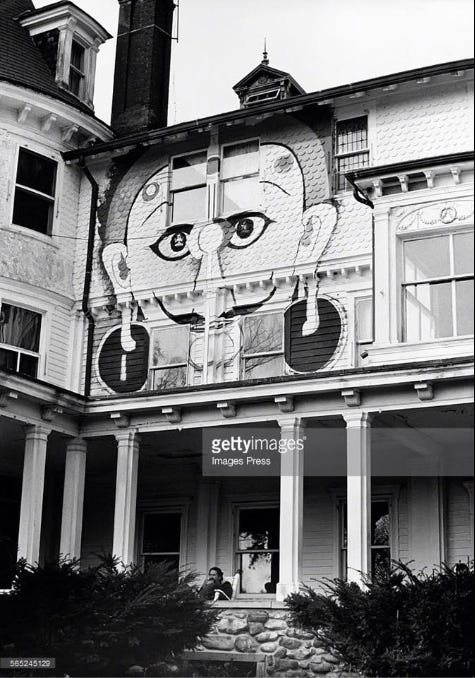
“Leary’s harassment, arrest and arraignment were instigated by none other than that felonious Watergate co-conspirator, G. Gordon Liddy , who at the time was Dutchess County’s assistant district attorney.” He also raided Bard annually and put undercover narcs in the building and grounds department. I was lucky to live off campus; I couldn’t deal with scenes like that. When I got stopped on the way to class holding a wet oil painting out of the driver’s window I got so mad and frustrated that my speech started to slur.
“Are you on medication?”, the State Trooper asked. I was still a blend of high ideals and high dungeon when challenged by authority figures, especially ones like this one doing a phony ‘safety stops’ looking for weed and pulling on my emergency brake cable, claiming it was too loose. I’ve since learned it is better to treat cops like your younger brother but back then, time and again the most routine encounter would escalate, the handcuff would come out and I’d get carted off to jail.
So the idea that they could roll up anytime, put yellow crime tape around the dorms and arrested people willy nilly, people jumping out of windows, completely upset my world. My father tried to get me to understand that authority was arbitrary by doing things like lowering my allowance out of the blue. This was an idea that never quite took and sounded more like ‘authority is absurd’ but I’d never seen it in action out in the world. There was no outcry from the parents, one of whom had to take out a second mortgage to pay for lawyers.
Absurdities: “Orders from the D.A. ...that would be…
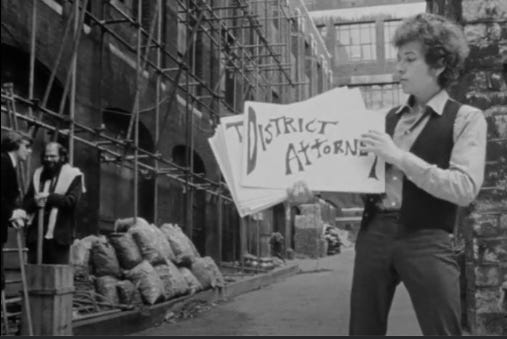
G. Gordon Liddy Assistant D.A. of Dutchess County making a name for himself by raiding Bard campus regularly and bringing charges against a bunch of students and, like today, doing stupid stuff on purpose like detaining the drama teacher who had a show opening the next day because he had a bottle Empirin on the seat next to him. Evidence: lab test.
Also put undercover narcs in the building and grounds department with the schools approval. More absurdity: the Dean of Admissions, a proper woman of a certain age, with her grey hair in a bun to prove it, got stopped on the Taconic State Parkway simply because she had a Bard parking lot sticker on her back bumper. I realize this sounds like nothing compared to what’s happening now, but I had nothing to compare it to.
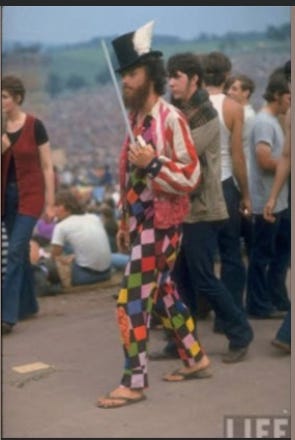
I remember when the Hog Farm/Pranksters came to Bard. New York was a police state in a happy moral panic over long hairs and we were the poster people for everything shaking things up. So no, we weren't going much farther than growing our hair, no top hats with wings and the Checkered Demon look. They weren't a hit at Millbrook either. Having said that I was fascinated, still am.
Today it’s people IN the government trying to overthrow it. Pegs the cognitive dissonance meter for those of us identified by our haircut back then as horrible people because we thought the gov could use a serious dose of tweekage, whether we were engaged in the resistance or simply trying to stay high in peace until our college deferment ran out.
I remember when the SDS firebrand came to Bard, gave his pitch, everybody said YEAH! “Right On!” and then turned as one and filed out “sorry man, I got a two week project due” leaving him and his sign-up clipboard, standing there, looking truly surprised.
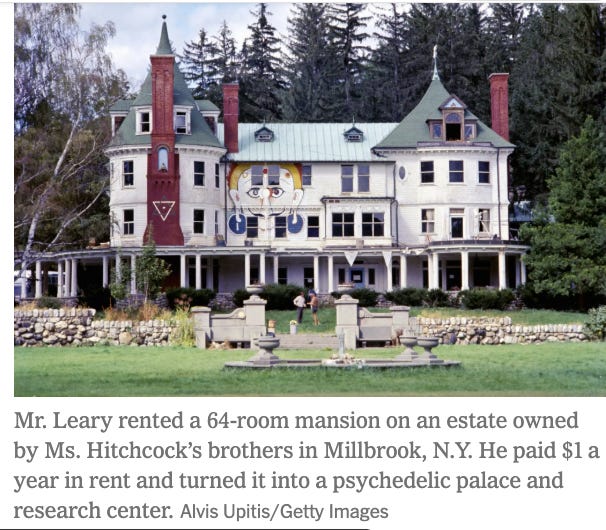
The Castalia Foundation one of many of Peggy Mellon’s efforts to move things along.
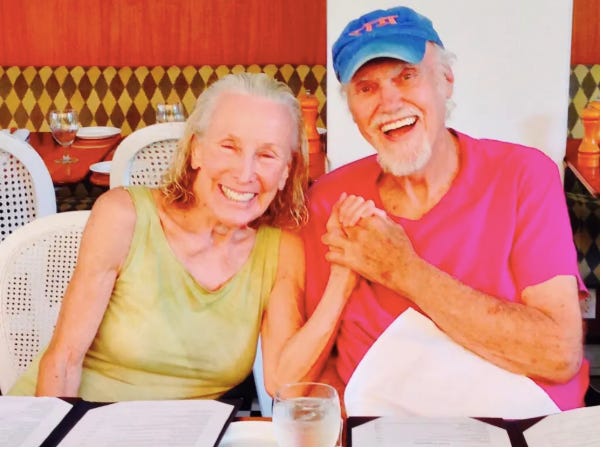
Here they are, still pals in 2011.
Tim Mellon, who got his name in the paper recently by forking over $125,000,00 to give us Trump, is the grandson of Gilded Age tycoon and former U.S. Treasury Secretary Andrew Mellon.
Peggy Mellon was the granddaughter of oil magnate William Larimer Mellon Sr. founder of Gulf Oil (Andrew Mellon’s nephew)
When Joe Stalin faced severe shortages of foreign currency to fund his first Five-Year Plan of rapid industrialization, he secretly sold off dozens of priceless masterpieces from the State Hermitage Museum in Leningrad.
Andrew Mellon was there with the equivalent of 40 million in today’s money, which would not buy even one of the haul today. “The Soviet sale of Hermitage paintings between 1928 and 1931 resulted in the departure of some of the most valuable paintings from the collection of the State Hermitage Museum in Leningrad to Western museums. Several of the paintings had been in the Hermitage Collection since its creation by Empress Catherine the Great. About 250 paintings were sold, including masterpieces by Jan van Eyck, Titian, Rembrandt, Rubens, Raphael, and other important artists. Andrew Mellon donated the twenty-one paintings he purchased from the Hermitage to the United States government in 1937, which became the nucleus of the National Gallery of Art in Washington, D.C.

The Alba Madonna by Raphael, was bought for the Hermitage by Emperor Nicholas I of Russia in 1836. It was sold to Andrew Mellon by the Soviet Government in 1931 for $1,166,400, the largest sum ever paid for a painting until that time.
The sale remained secret until November 4, 1933, when it was reported in The New York Times that several Hermitage paintings, including the Crucifixion and Last Judgement diptych by van Eyck, had been purchased by the Metropolitan Museum. [https://en.wikipedia.org/wiki/Soviet_sale_of_Hermitage_paintings]
I digress, but in its own way this was commensurate with bringing LSD to the masses. At twelve I road my bicycle there, innocently taking in the paintings, my paintings, my favorite Vermeer, Leonardo, getting a crush on Fragonard’s Girl Reading a Book. When I went back on a visit thirty years later it hit me full force, seeming to neatly gather up all the visits going back to when I was twelve and in such a way that I was re-seeing everything with eyes of a now forty year old. At twelve it was "my" collection and I took it for granted that, like the movies that came to town two months after they opened in New York, a little behind.
Now there were Masterpieces looming from every wall. I got Stendal Syndrome. Embarrassing, I thought it was fictive, an affectation or an artifact from a more refined time of fainting couches and smelling salts.
Stendal Syndrome, overcome by an excess of beauty, turns out to be about as much fun as car sickness. Like a carnival ride going too fast my stomach got queasy and the power started to drain from every limb. I had to get out of there, fast. Literally shielding my eyes from an entire roomful of Velasquez on the way, I found my way to a side door and sat down.
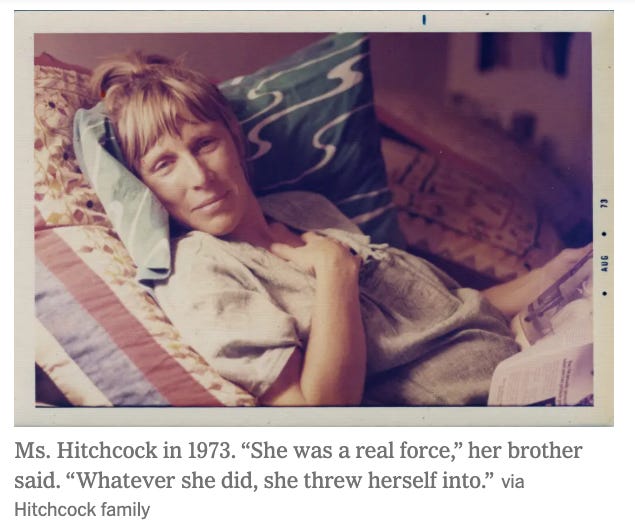
Back in Millbrook [from the NYT] “Mr. Leary and Ms. Hitchcock fell into an on-again, off-again love affair. (She described it to Robert Greenfield, Mr. Leary’s biographer, as “a swinging door relationship.”) Ms. Hitchcock had been dating Allen Eager, a jazz saxophonist who was also a heroin addict, Mr. Greenfield wrote, and when her mother heard that she was involved with Mr. Leary, she exclaimed: “Oh thank God! She’s going out with a Harvard professor!”
“She was not there when G. Gordon Liddy raided the place in 1966; in those days, Mr. Liddy, who a few years later would be caught up in the Watergate scandal, was working in the local prosecutor’s office, and the town was suspicious of Mr. Leary’s antics. But she was in residence in 1964, when Ken Kesey and the Merry Pranksters barreled up in Furthur, their psychedelic school bus — blaring rock ’n’ roll, hurling green smoke bombs and totally harshing the Millbrook crew’s more contemplative buzz.”
“Timothy Leary hadn’t yet been thrown out of Harvard for his experiments with psychedelic drugs when he met Ms. Hitchcock one weekend at the apartment of Maynard Ferguson, the jazz trumpeter and bandleader, in the Riverdale section of the Bronx.
“Pretty Peggy Hitchcock was an international jet-setter,” Mr. Leary wrote in his 1983 autobiography, “Flashbacks,” “renowned as the colorful patroness of the livelier arts and confidante of jazz musicians, racecar drivers, writers, movie stars. Stylish, and with a wry sense of humor, Peggy was considered the most innovative and artistic of the Andrew Mellon family” — that is, the family of the Pittsburgh industrialist who was secretary of the Treasury under three presidents…
“When Mr. Leary and Mr. Alpert’s careers at Harvard blew up in 1963, Ms. Hitchcock found a new home for them and their coterie. Her younger twin brothers, Billy and Tommy, had just bought property in the Hudson Valley village of Millbrook: 2,500 acres of rolling hills and woods with stables and outbuildings and two mansions. The brothers weekended in one, a place they called the Bungalow. The other, half a mile away, was a fanciful, if run-down, turreted 64-room white clapboard confection. They rented it to Mr. Leary for $1 a year, and he soon turned it into a psychedelic palace and research center…
“Meanwhile, Mr. Leary had fallen in love with Nena von Schlebrügge, a successful (though ambivalent) fashion model, whom he married at near Millbrook at Wynn and Sally Chamberlain’s, the Quadrangle
. Then Ms. Hitchcock married, and divorced, Louis Scarrone, a doctor. Inevitably, the Millbrook scene disintegrated into chaos, and both women embarked on their own adventures, and away from Mr. Leary.
Ms. von Schlebrügge took off with Robert Thurman, the ex-monk and Buddhist scholar, whom she met in the kitchen of Millbrook while trying to get Mr. Leary to sign their divorce papers.
Sally Chamberlain
“1966, in Wynn’s Studio at The Quadrangle. Happy Birthday Nena Thurman. Remembering good times with you”
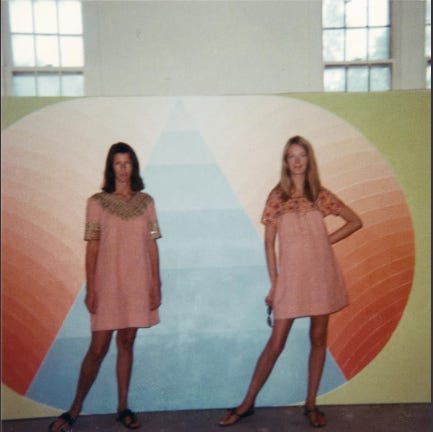
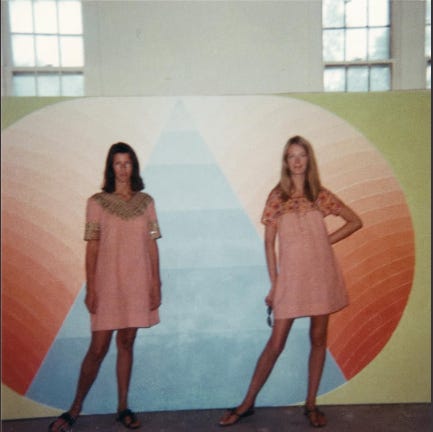
I remember this painting in Wynn’s studio during my brief career as an assistant [more of a charitable effort to keep me this side of crazy, for which I am grateful for to this day] and a conversation when I called it slow motion action painting because of the way the curves followed the arc of his arm. The art world had run so many frantic next must have things by then, in the free for all that followed the hegemony of Abstract Expressionism: Pop, Photorealism, Op, Minimalism, Happenings, Performance art, and finally erotic art which Wynn made a splash by painting half a dozen poets nude and clothed. Did bring out the observation by him that eroticism leans heavily on naturalism, an oversimplification perhaps but Dali for one painted in old master technique. It was the favorite dodge if you had no hand for abstract painting to fallback on realism but make it surreal.
One of the the things Wynn did that caused a stir was his exhibition “Poets Dressed and Undressed” (1964) — a double portrait of Frank O’Hara, Joe LeSueur, Joe Brainard, and Frank Lima — which caused quite a scandal at the time. The gallery had to post a security guard at the door to keep minors out. 1964 was a long way from Robert Mapplethorpe doing himself a big favor with a whip in a Berkeley Museum in 2001. Here is the introduction that Allen Ginsberg wrote that was shown on a large bright green panel at the show.
“Why am I interested in seeing myself naked? Because for years I thought I was ugly. I still do, but I no longer look at myself through my own eyes, I look out – my eyes look outward at my Desire, and I reach out to touch the bodies I love without fear that I’ll be rejected because I’m ugly. Because I don’t feel ugly now, I feel me – more than that, I feel desirous, longing, lost; mad with impatience like fantastic old bearded Whitman to clasp my body to the bodies I adore. So I’m interested in nakedness, I love my old loves’ nakedness. I love anyone’s nakedness that expresses their acceptance of being born in this body, in this flesh, on this planet that will die … So Chamberlain has painted every body naked – modern Joves, Ganymedes, Aphrodities, etc., if you want a tradition – modern friends as they really are to themselves with their naked babies lifted in triumph on bacchic friends’ shoulders stepping forth from the picture toward society; happy, victorious, still alive, photographic, fleshy, truthful to their own birth without clothes.”
In the book In Memory of My Feelings: Frank O’Hara and American Art, Russell Ferguson writes:
“Wynn Chamberlain’s audacious double portrait of 1964 first shows O’Hara, LeSueur, the artist Joe Brainard, and the poet Frank Lima dressed in bourgeois office attire. They stare somberly at the viewer. In the second version they are completely naked, and all four sport cheery grins. Chamberlain overtly invokes the playful quality that some gay men of the period could bring to the masking and unmasking that was an unavoidable part of their lives.”
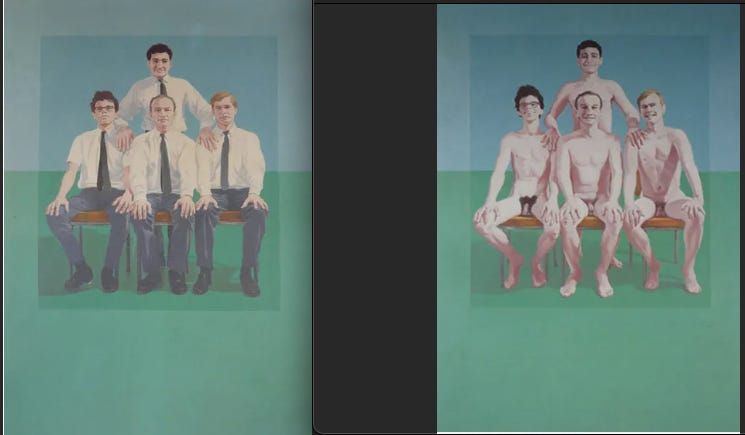
Here’s how Brad Gooch describes it in his O’Hara biography, City Poet:
“Working from photographs taken at his studio, Chamberlain had painted nude photo-realist cavnases of personalities from the world of art and poetry, including Ruth Kligman [Jackson Pollock’s lover], John Giorno, Bill Berkson, Tony Towle, and Allen Ginsberg. O’Hara appeared in the middle of two group shots — one clothed, one nude — with Brainard, LeSueur, and Lima. The show’s flyer, featuring nudes of Kligman, Giorno, and Chamberlain striding forward, was banned by the postal authorities … Allen Ginsberg wrote an introduction, meditating on his feelings on seeing his own naked body. With the press getting wind of the scandal, the gallery was forced to post a security guard at the door to keep out minors.”
The Times obituary for Chamberlain opens with a description of an event that suggests the exciting confluence of different media and art and literary movements in the mid-1960s — a huge gathering that Chamberlain hosted in 1965, at which William S. Burroughs read from his work. On April 22, Chamberlain’s studio loft
“became the center of hip, artsy New York when Mr. Chamberlain, who was best known at the time for painting poets in the nude, hosted a literary gathering that featured a reading by William S. Burroughs, the author of Naked Lunch.
The crowd of 130 people — including the pop artist Andy Warhol, the painters Larry Rivers and Barnett Newman, the composer Karlheinz Stockhausen, the poet and art curator Frank O’Hara, and the photographers Diane Arbus and Richard Avedon — was appreciative as Mr. Burroughs read, with his characteristic eccentric delivery, a futuristic short story. As The New York Times described it, he ‘livened up his one-syllable-at-a-time reading with sudden bursts of dramatic activity, eventually ripping down a white-sheet backdrop and uncovering a painting of horrifying tarantulas.’
Mr. Chamberlain, who was a pal of the poet Allen Ginsberg and the avant-garde composer John Cage as well as a member of the Warhol cohort, was clearly at home in a gathering of eclectic artists, perhaps because his own career in the arts was pretty eclectic.”
Chamberlain was close enough with O’Hara that he visited the poet as O’Hara lay dying in the hospital after being struck by a dune buggy on Fire Island in 1966. Gooch relates that just as Willem de Kooning (who absolutely adored O’Hara) emerged from visiting the gravely injured poet in his hospital room “he was faced with Wynn and Sally Chamberlain holding flowers. ‘Bill de Kooning came out crying,’ recalls Wynn Chamberlain. ‘I’ve never seen him like that, just weeping. When we went in we realized Frank wasn’t going to live. He looked like a Francis Bacon.’”
Chamberlain had wide-ranging interests — as the Times notes, “in addition to painting, he produced an early play by the satirist playwright Charles Ludlam; he made a movie, ‘Brand X,’ that some consider an underground classic; and he wrote novels set in locations like Morocco and India, where he spent a great deal of his later life.”
[https://newyorkschoolpoets.wordpress.com/2014/12/09/wynn-chamberlain-1927-2014-painter-of-poets-dressed-and-undressed/]
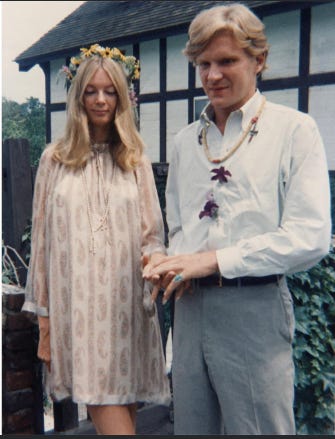
Bob and Nena Thurman got married at The Quadrangle
(Married since 1967, the Thurmans became a kind of Buddhist power couple and the parents of the actress Uma Thurman.) And Ms. Hitchcock had begun a romance with Walter Bowart, a counterculture journalist, and moved with him to Arizona.
However, before the move to Arizona Walter Bowart, “founder of The East Village Other, a newspaper, as Margalit Fox wrote in her obituary for Mr. Bowart in 2008, so far out that “it made The Village Voice look like a church circular” calls Bob Simmons, one of his writers and in Bob Simmons telling: “high on something, called me up and said, “Bob, you are the only straight-looking guy we have around the office. We have to do something for Leary. He just got busted up in Millbrook.” Hmm.
So Walter and I cooked up this scheme. I would call up the sheriff of Dutchess County, one Lawrence Quinlan, and I would put on my regular work suit and drive up to Poughkeepsie to interview him.
Of course we knew that the sheriff wasn’t interested in talking to anyone from a hippie rag like EVO. So what did I do? I called up the sheriff and told him my name was Bob Simmons, a stringer for Look magazine, and that my editor asked me if there was a chance I could come and do a short interview for the magazine about the arrest of Dr. Leary.
You would think God had called for an audition. ”Certainly,” came the reply. “Sheriff Quinlan would be happy to talk with you.”
So, there on a weekend in the spring of 1966, Walter Bowart, Timothy Leary, and Bob Simmons crammed into my Karmann Ghia VW and buzzed up to Poughkeepsie to the headquarters of the Castalia Foundation .
Tim Leary was in my VW. The man. Seemed like a good dude. Walter was folded up like an accordion in the back seat. We motored upstate gabbing like magpies. We pulled into the estate of William Hitchcock Mellon where the rich folks had given refuge to Leary and his merry band. I was blown away. The main building was four stories high with turrets, gardens and verandas that went on forever. There was a tiger head over the mantel of the main fireplace. To Tim Leary it seemed normal; to me, it was otherworldly. Never mind all of that. I was up there with a job to do.
Walter had borrowed a small Uher tape recorder, which was a really cool device in those early days. On top of it, I had my Nikon camera, and I was wearing a tan suit with a white shirt and a black tie. Most of all, I was sporting short hair. No wonder the sheriff didn’t ask for a letter or any credentials. Who wouldn’t trust a clean-cut white boy like me?
I drove over to the office per instructions and was escorted in to talk to Sheriff Quinlan. I asked him all the standard questions. “Why had they decided to raid Millbrook and the Castalia Foundation? What was going on over there? Were there drugs? Were people taking LSD? Smoking pot? Having sex with animals?”
“Sheriff, aren’t you worried about the drug menace? Don’t you think this Leary guy is the Pied Piper leading America’s youth down the road to doom and destruction? How did you get the goods on them? Was there surveillance?”
Sheriff Quinlan was forthcoming and anxious to proselytize. We got it all on tape. Somehow I got out of his office without ever having been challenged as to whether I was actually from Look. Whew! I went back to Millbrook and played the tape for Tim and Walter. “Wow.” This was going to be funny.
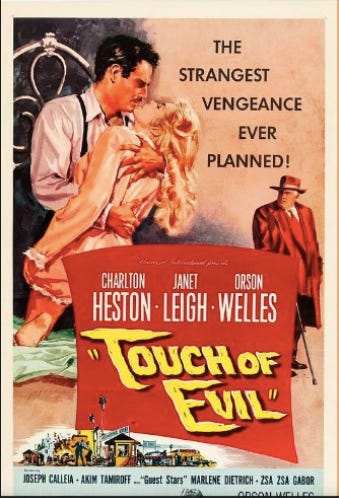
A couple of days later, the story was on the front page of EVO. “A Touch of Evil” read the headline. Walter loved the fact that the name of the corrupt officer of the law in Orson Welles movie, “ Touch of Evil ,” also was Quinlan.
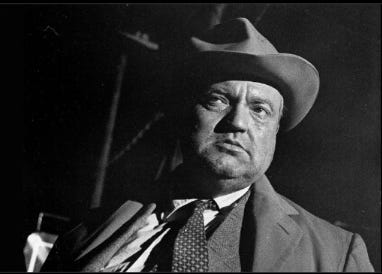
The picture I took of the hapless publicity-hungry sheriff of Dutchess County ran alongside a picture of Orson Welles as evil Police Captain Hank Quinlan of Laredo, Texas. All we needed was Charlton Heston.
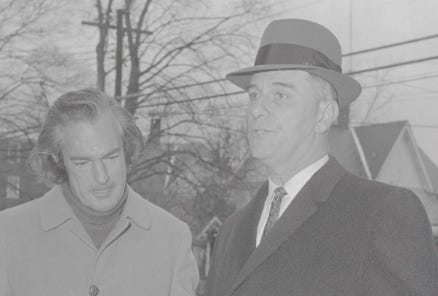
Walter ran my interview with the sheriff as the lead story. He later gave the tape to Jonas Mekas, who turned it into a film called “ Report from Millbrook .” It was all a joke on the Sheriff and the whole sanctimonious lot of them. I was mainly glad that no one arrested me for impersonating a magazine reporter.”
Liddy was still nuts in 2005 when this was written [https://www.huffpost.com/entry/my-interview-with-g-gordo_b_134364]
“The Fuhrer was G Gordon Liddy's first political hero. Liddy was a sickly, asthmatic child when he grew up in Hoboken, New Jersey, in the 1930s. The town was full of ethnic Germans who idolized Hitler. … His beloved German nanny taught him that Hitler had - through sheer will-power - "dragged Germany from weakness to strength."
This gave Liddy hope "for the first time in my life" that he too could overcome weakness. When he listened to Hitler on the radio, it "made me feel a strength inside I had never known before," he explains. "Hitler's sheer animal confidence and power of will [entranced me]. He sent an electric current through my body." … "Ecstatic, I drank in its colossal power and felt myself grow. Fear evaporated and in its place came a sense of personal might and power."
A-ha. So, Mr Liddy, do you feel that your early, formative love for Hitler shaped your political behavior later in life? "Oh, no," he says somberly. He renounces Hitler's war against the Jews as "evil" and flaunts his support for Israel's hard right as evidence he is not an anti-Semite. "It was part of my childhood, that's all," he says.
He used to take his kids to see Leni Reifenstahl's Nazi propaganda movie 'The Triumph of the Will.' When he was a kid himself, he went to insane ends to test his will-power. He stood in front of approaching trains, telling himself he would not die because "I am a machine too." During lightning storms, in order to demonstrate to himself to power of his will, he would climb onto tall trees and yell, "Kill me! Kill me!"
He even trained himself to kill animals in anticipation of becoming a brutal soldier. He describes beheading chickens with glee: "I killed and killed and killed, and finally I could kill efficiently and without emotion or thought. I was satisfied; when it came my turn to go to war, I would be ready. I could kill as I could run - like a machine."
It looks like a crazed rant on paper - but as we drive through the East Village, his tone is so reasonable, his voice so soft, he could be talking about the weather. "Yes, I believe the will is very important. It's how I have succeeded in life,"
This from Journalist Dan Baum's article featuring John Ehrlichman’s infamous quote on the war on drugs was published in the April 2016 issue of Harper's Magazine, titled "Legalize It All: How to win the war on drugs."
“You want to know what this was really all about?” Ehrlichman asked, referring to the war on drugs.
“The Nixon campaign in 1968, and the Nixon White House after that, had two enemies: the antiwar left and black people. You understand what I’m saying? We knew we couldn’t make it illegal to be either against the war or black, but by getting the public to associate the hippies with marijuana and blacks with heroin, and then criminalizing both heavily, we could disrupt those communities. We could arrest their leaders, raid their homes, break up their meetings, and vilify them night after night on the evening news.”
I’ve always wondered if these people factored in that their own children were going to get caught up in their scheme as heroin tore through their ranks. A dear friend, Lee got fifty years for two joints sold to him by FBI agents. I always picture him sitting on his front porch in New Orleans with a shotgun across his knees during a flood. He was a community organizer in the civil right movement, thus the two joints. He led an escape with twenty six others and fled to New York, leaving a wife and child behind. All of the others were captured. Uprooted and put out of action, he lost his life to heroin within a few years.
“Did we know we were lying about the drugs? Of course we did,” Ehrlichman concluded, according to Baum.
Tim Leary he was arrested in 1968 for possession of two joints. For these joints of cannabis Leary was given 20 years in prison. Leary escaped from his low security prison and, with the help of the leftist militant group the Weathermen, For a fee, paid by The Brotherhood of Eternal Love (your source and mine for Orange Sunshine), he and his wife fled to Algeria where he hooked up with the Black Panther Party. He was soon returned to prison in the US and Leary would remain in prison until 1976 until he was freed by Governor Jerry Brown. All for two joints.
photo: DEA
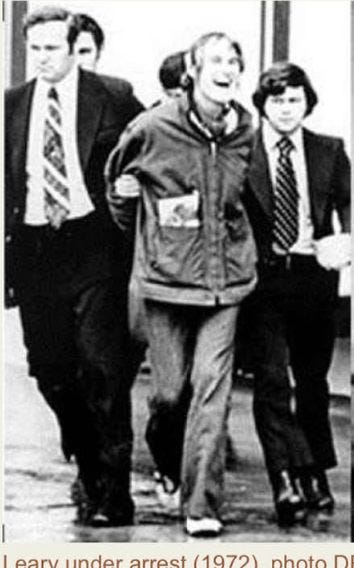
I saw Timothy Leary speak at the University in Gainesville Florida
Right after he got out of prison and he was shilling colonizing outer space. One of the suggestions he made was that gay people could have one of the giant spinning tubes to themselves. He had such charm I found myself believing it for a few seconds here and there, although it sounded like something cooked up in solitary confinement with a gay ghetto thrown in.
They put him in a cell next to Charles Manson. The only comment I remember was Tim saying that when he looked at Charlie he imagined a circle around his face and repeated silently ‘you don’t exist.’ This sort of works actually.
The last time I saw him was at Camp Winnarainbow, Wavy’s circus performance camp. He came with a bunch of latter day Pranksters in the replica Furthur. He was already sick so the gaiety played like a re-enactment but at the end of their frolic He stood up. He was dressed like Merlin in a purple robe with a tall peaked cap, like a dunce cap only purple. It made him seven feet tall and when he stood up and raised his arms I felt a blast of energy from sixty yards away. Thought of him differently ever since.…not everybody can do that.
I really enjoyed reading this. Seeing the history, and the presence of Ram Dass and Robert Thurman woven through, brought back memories of learning from their work in my own way, though not in those wild days. Thanks for sharing these glimpses behind the scenes.