
Early Father’s Day Message

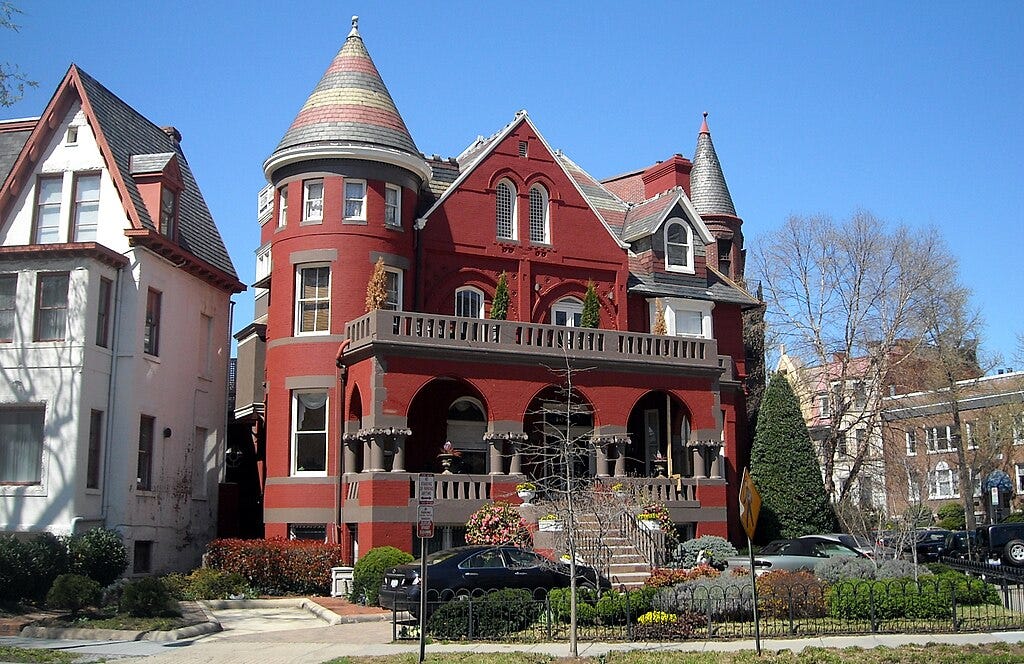
Photo; childhood home by Dupont Circle, something else that was never mentioned. I only found it by accident online. It’s now a bed and breakfast so I could see the inside as well.
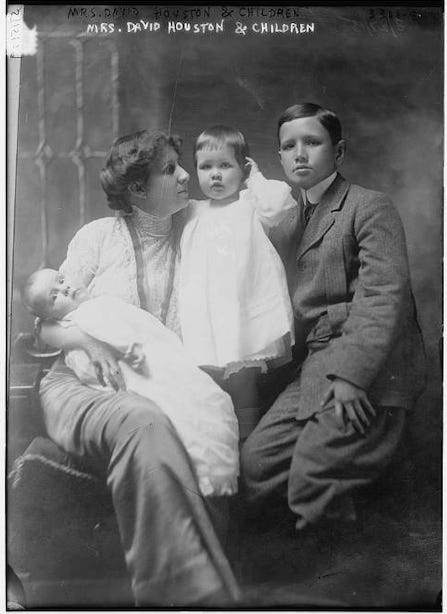
My Father as an infant. That’s a kick in the head; again from the Library of Congress. I don’t believe he had any family albums. As someone said of his Father, “He was interested in Humanity, not so much interested in humans.”

Woods Hole was one of our stops in the Summer because that is where Katie Turner lived, my Father’s nanny. She came by herself from Ireland in 1912 when she was nineteen. He was born in 1913, she had raised him from infancy. She and Dad were ridiculously happy to see each other. I never saw him this lighthearted with anybody else. I have never heard him talk about either of his parent much less light up like this if they were mentioned. Her house was neat as a pin, with her husband’s cigar smoke filling in for the smell of a peat fire.
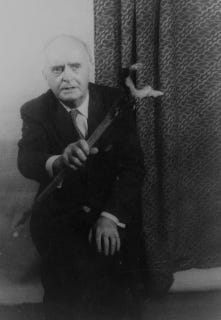
Paidric Colum stayed at her house, no idea how they got connected but I was struck by his very private atmosphere the one time I met him as he was leaving. He must have been eighty. Between his rounded back and an all-over tweedy fuzz, he reminded me of Badger from the Wind in the Willows.
I hadn’t read Joyce of course but could tell by the way people said his name that he was someone special and was vaguely aware of Yeats but was impressed to have met someone who helped type Finnegan’s Wake. He was a children’s writer, playwright and folklorist as well as a member of the Irish Republican Army. Here he has turned his hand to an opera fantasy of Hansel and Gretel 1954
Stray memory: excitement....there was a spill of a large amount of mercury on the wharf of the Oceanographic Institute and we rushed over on our bikes to try to gather what was left in the cracks. Almost impossible as it would squirrel out of the way and fall though the first opening. One more: we came out of church one Sunday when there was a good sized storm that felled a tree during mass. When we stepped outside when mass was over the first thing I saw was my Father in his blue bathing trunks, that made him look like Superman to my eight year old eyes, directing traffic around the tree in the pouring rain and wind. I didn’t know you could do that, appoint yourself a traffic cop.
I filed this bit of information only to retrieve it at sixteen on a rainy day in Fall River when the driver of the car I was in reached under the seat to get a rag because the windshield had fogged over, missed the stop sign and got smacked in the passenger door by a big black Cadillac.
Still in shock from seeing all that chrome and shiny black metal headed right to my door, I decided I needed to get the upper hand as best I could since it was clear we were at fault. Just as well because the other driver started trouble by saying that one of the underage girls was driving. Somehow the very energy that made me resist authority figures worked in my favor when I needed to play one. The guy was thrown off by being talked down to by this sixteen year old channeling his father.

One last note: the eye of Hurricane Donna in 1960 passed right over the house, a clear blue hole going right up to blue skies. In my memory there are birds flying around in it but it may have been leaves and bits of things that had been lifted up. We went out to see. Dad, the sailor, was happy as a kid with this rare visit.
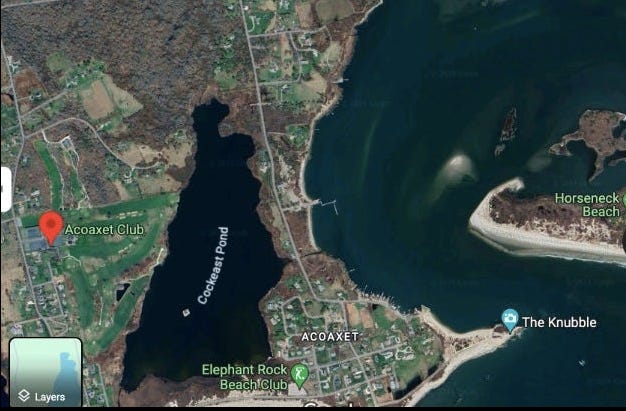
Acoaxet looks like the maps I used to draw in class, of smuggler’s Coves: a place to duck in behind a towering rock leading to a forked river and a pond right by the shore with a tiny island in the middle.
Never knew he got fired. The story was that he was in favor of early retirement to let younger people have a chance. Schesinger who fired him served for 17 weeks as Nixon’s Ax Man. He fired 4,000 CIA employees. This sounds oddly familiar
“During more than two decades of service, Mr. Houston has compiled a record of achievement so extraordinary that, joined with his devotion and thorough dedication, he has become a key adviser to me as to all other Directors of Central Intelligence. Unquestionably the effects of his panoramic contributions to the Agency and to our country will endure. They will remain as witness to his expertise, to his character, and to his superlative capacity in responding to the challenges of our national security and the dramatic times in which we live.”[3]
[This quote is from a 1970 nomination statement made by the Director of Central Intelligence honoring Lawrence R.Houston for a National Civil Service League Career Service Award. During an awards banquet in 1970, when Houston received the National Civil Service Association's Career Service Award, Richard Helms said:] This was given by Richard Helm, memorable for giving one of the eulogies at Dad’s funeral and for his two security detail bristling when I strolled up to thanks him. I didn’t see them to do that with anyone else. Lord knows how they had been briefed. I was so happy to have the complete sayings of Lawrence Houston and could now send mental termites to work on it, that I was walking two inches off the ground with a little smile on my face. Only one old friend understood, at least that I know of and that saved the day. The rest of the time I was treated by an assigned bomb squad.
When he appeared in dream after he died it felt as if we were peers, that the asymmetry of father/son had been dropped. I said, let's go up the street, I'll show you the schooner being restored. Right before we got there we came to a drop off of six feet or so. Should I help him, take his hand? He jumped down with no problem. I was still thinking of him as eighty two.
However, only three years later, Houston was unceremoniously fired by the incoming CIA Director, James R. Schlesinger, who went on a campaign to purge the CIA of everyone he felt loyal to Dick Helms.[12][The New York Times Obituary for Lawrence R. Houston (published August 17, 1995, following his death on August 15).]
According to CIA veterans, the most loathed Director of Central Intelligence was James R. Schlesinger. Schlesinger was head of the CIA for President Richard Nixon for 150 days in 1973, one the shortest directorships in the Agency’s history. It was also likely the most combative, with some staffers going so far to call Schlesinger’s leadership a “reign of terror”—an interesting turn of phrase for people involved in establishing actual reigns of terror around the world.
According to political scientist Christopher Moran, Schlesinger had to have extra bodyguards assigned to him as he traveled to and from CIA HQ in Langley, Virginia. Agency bulletin boards “were replete with unflattering caricatures.” Moran also notes that “reportedly, a special closed-circuit television camera was installed opposite his official portrait because of fears that it be vandalized by disgruntled employees.”
Then there was Schlesinger’s order for a list of all activities, past or present, that “might be interpreted as being outside the CIA’s legislative charter.” This was because the break-in at the Democratic National Committee office in the Watergate complex in June 1972 had CIA fingerprints all over it: two of the burglar/wiretappers were CIA veterans, a couple others had been anti-Castro Cuban CIA assets.
Nixon held a personal grudge against the CIA. Moran describes it as a “pathological hatred.” The East Coast prep school/Ivy-League country club types who dominated the early CIA were, Nixon believed, “Langley liberals.” He blamed them for tipping the closely-run 1960 presidential election to John F. Kennedy.”
[https://en.wikipedia.org/wiki/Lawrence_R._Houston]
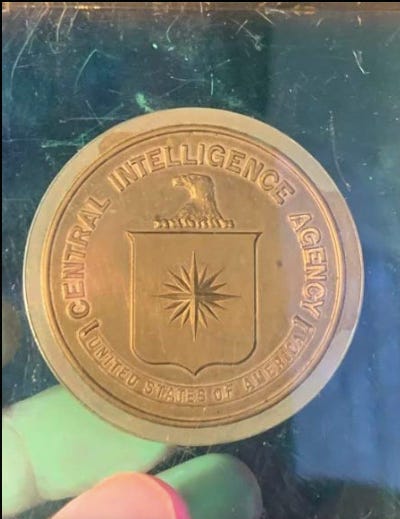
Found this in the back of Dad’s closet in a wrinkled grocery bag along with old hair brushes. He was bald. It used to be in his study. The only time I ever heard him say anything negative about the agency was in 1994 when the Aldridge Ames story broke. It was the last time I saw him. Since it was public knowledge he could talk about. The only thing I remember was him saying “It’s a scandal!!” but with such force like I had never seen before. Aldridge Ames compromised "virtually all Soviet agents of the CIA and other American and foreign services known to me" and had provided the USSR and Russia with a "huge quantity of information on United States foreign, defense and security policies". He died last January (2026) at his former permanent address in Terra Haute Indiana.
"Langley Liberals" is a new one one me. Looking more in the direction of a guy who had the task of fitting a secret police, who by definition did illegal things, into a democratic society.
I remember him saying on occasion out of the blue: “When you grow up, you are going to have to do things you don't want to do." I was too young to translate that as "hard day at work" and thought he meant things like homework.
Here is a fine example from a separate article:
“You can’t prove what the facts are.”
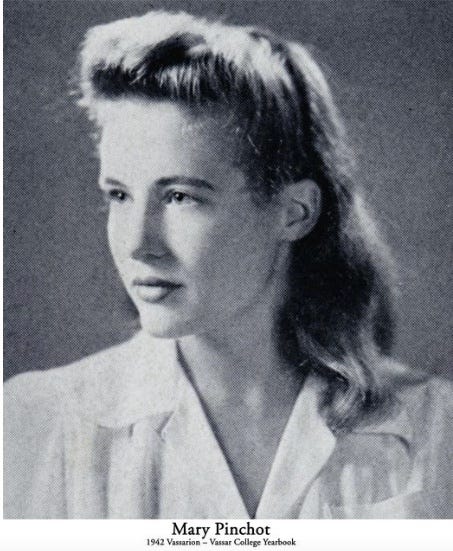
One of the saddest hellos, this story. I knew the C.I.A. wasn’t the Boy Scouts but I’d always got some distance from their doings as ‘official business,’ actions against adversary’s like the Soviets. I never thought they would kill one of their own, much less the wife of one of the high ranking members.
Angelton and his wife were supposed to meet with her that evening and when they found the house dark immediately panicked, thought it was her and searched her house looking for her diary. Then the next day Angleton and Ben Bradlee went to her studio found it and said all they found was a sketch book.
Mary’s Mosaic. It’s the most personal look into Kennedy’s assassination. This is part two of the author’s interview (part one is worth a gander, it’s just a little slow). He knew Mary as the mother of his best friend. In writing the book he finds his father is involved. I knew some of the characters as my father was General Council of the C.I.A. Once I asked him how a bullet could make two right angle turns like that. He made a dismissive snort with a weird little smile which translated ‘don’t you know that’s a joke/ don’t ask a single thing more.
To be honest I could hardly finish the book; it cut so close to the bone.
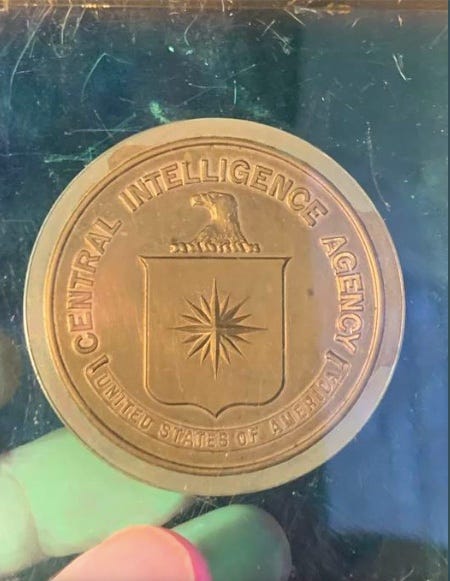
Found this in the back of Dad’s closet in a wrinkled grocery bag along with old hair brushes. He was bald. It used to be in his study. The only time I ever heard him say anything negative about the agency was in 1994 when the Aldridge Ames story broke. It was the last time I saw him. Since it was public knowledge he could talk about. The only thing I remember was him saying “It’s a scandal!!” but with such force like I had never seen before. Aldridge Ames compromised “virtually all Soviet agents of the CIA and other American and foreign services known to me” and had provided the USSR and Russia with a “huge quantity of information on United States foreign, defense and security policies”. He is still alive, 82, living in Terra Haute Indiana, at, you might guess, a permanent address.

Allen Dulles was my Father’s mentor. Allen lived around the corner and the last time I saw him was at the bank. He was in bedroom slippers. “The poor man has gout” my Mother said. Dad’s reputation was that he kept the C.I.A. out of trouble by telling it what it could do and less often what it could not do. About the only comfort I could get out of this arrangement was that someone was going to do his job and he looked like a good choice what with his cool seeming dispassionate and unflappable demeanor.
When Richard Helm gave the eulogy at Dad’s funeral and I always think of him saying, “I never felt more like an agent of the President’s secret police than when I left the Oval Office carrying the baton of the order to make the economy of Chile scream in the run up to overthrowing Allende.” Nixon was the only President I ever heard Dad speak against.
Electoral politics was treated like as a passing show, we didn’t even have the vote until Kennedy. Although I never heard him say anything against Kennedy he showed no sign of getting caught up in the Camelot euphoria either. I never knew Catholics were seen as weird and in the thrall of the Pope until then either.
It was useless to try to get anything out of Dad other than him scoffing at the newspaper’s account and the standard reply, “There’s more to it than that.” At the end of his life I asked him about the magic bullet that made two right angle turns and continued on to him Connelly in the shoulder and the leg. As I said above, he made a sound like a horse flapping its lips. He had a whole lexicon of those sounds for use on off limit subjects, this was one of the strongest.
If you pestered him with too many questions, before long he would wheel out his idea of a joke which was to ask if we’d heard of the Lake in Massachusetts named You Fish on Your Side, I Fish on my Side, Nobody Fish in the Middle. We didn’t think it was funny.
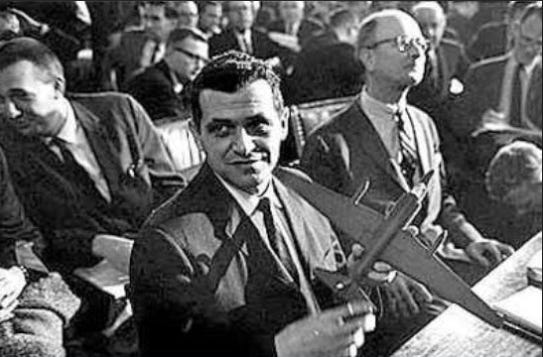
My Dad on the right with Francis Gary Powers holding a model of the U-2. There was a similar model at home on the mantel. It was the only time he tipped his hand a little, let the family have peek at something he was doing. He had cultivated the image of being a grey figure way in the background at the C.I.A. so when this picture showed up on the front page of the Sunday Times a lot of people were surprised.
They were in front of a Senate Armed Services Select Committee so the Congressmen could act appropriately startled by the news that a spy agency spies. Many of them were thoroughly briefed on what was going on but this was in the day when Ike could get up at a news conference and say “I only know what I read in the papers” and not have anybody bust out laughing. Less than a year later the Bay of Pigs ended what they called the golden age of the C.I.A. This is in 62 when Powers had been swapped for Soviet Colonel Rudolf Abel, a senior KGB spy who was caught in the United States five years earlier.
He was in O.S.S. during the War in Cairo running people to the Balkans. He went over there and wound up in a three way dispute between partisan group fighting the Germans and each other. He was also in Italy.
I know very little about any operations. He made the contract for the U-2 and landed on the front page of the Sunday Times surprising his brother in law’s family who thought he worked for the State Department. That he could talk about because it was public knowledge. I know he always had a smile on his face when he came back from the skunk works or Edwards.
He was close friends with James Donovan who was General Counsel for O.S.S. during the War and went on to negotiating the release of the prisoners from the Bay Of Pigs. Mr. Donovan was kind enough to get me a job when I got out of Payne Whitney. It was to be the receptionist at a building Pratt had bought, a former pharmaceutical company or lobbying group’s place on Park Avenue near Grand Central.
I answered the phone for the only two people there in the daytime, a guy Pratt had kicked upstairs who was a star fundraiser who nobody could stand and his secretary. No idea what they did. The guy was a hopeless artist and had an archive of his prints that he had grad students make for him. Technically complicated but when you came down to it woozy swishes of color.
Then in the evening there was a class and I had to make sure these post grad “students” signed in. They needed no help. One night they invited me up to the class. It was on international affairs. Right in the middle of it I finally put two and two together. What exactly did Pratt need with an off campus evening class in international affairs? Don’t think these guys went to Pratt. Did not look like art students.
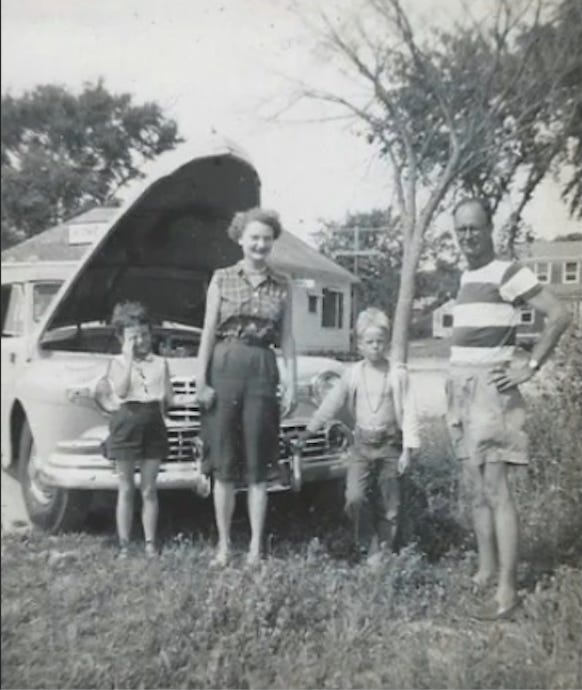
Padanaram 1955 just arrived from the drive from Washington with stops along the way at friend’s houses. First in Baltimore which was the only time my Mother saw her Father. It was only recently that I thought that was odd, Baltimore was barely an hour away.
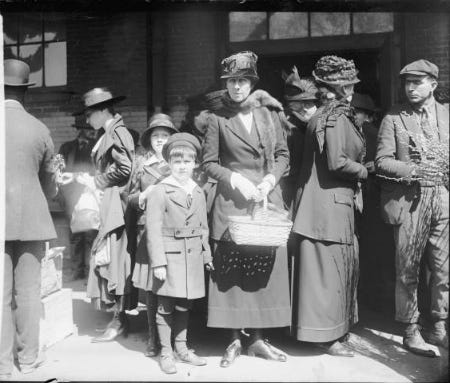
At a market in Washington DC. My father never talked about his childhood. Have I said that enough times; it’s an unqualified ‘never’. Photo is from the library of congress. The only story I have from my father's childhood, which was told by my Mother exclusively, is of him and his nanny Katie Turner (who came by herself from Ireland at eighteen) going to the movies and buying an eskimo pie which he put in his pocket to save for later. Refrigeration, the latest thing. I thought of it looking at the tiny basket his mother has brought to go shopping.
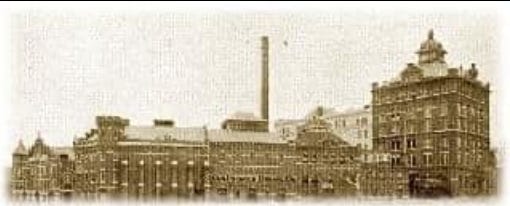
Forging Hungarian money in the early days of the C.I.A.
The offices were in WWll temporary buildings next to the Heurich brewery. You could see the brewery from our house in Georgetown . It was a big Victorian brick building with a cupola on top with a light in it.
Since my Dad was the General Counsel I decided the the cupola must be his office, thinking general meant general as in general in the army.
My Dad’s second attempt to tell a C.I.A. story involved the brewery. His first attempt had him closing his eyes, and stroking his forehead, sweating. I had no idea it would be so difficult for him. He prefaced it by saying that it was ok because it had been twenty five years. The story was from 1942 and it was now 1980 so this was leaving a wide margin, just to be prudent. It was about mediating between three partisan groups in the Balkans who were fighting each other instead of the Nazis. I couldn’t really follow it but it looked like torture so I didn’t ask, could you go over that part again about…
The second attempt went like this: They needed lots of money for agents going to Hungary. This was before the revolution, so 53, 54 something like that.
The solution was straightforward; forge the money. They had the guy they found set up at their offices. Things were going quite well at first but then the guy broke out in a terrible rash which made it impossible to work.
It would clear up and everything was fine for a week and then it would be back. I don’t know if it was him or someone else who noticed that it always struck on Thursday which was the day that they shoved a huge pile of mash out of the brewery next door. He was allergic to the mash. So they were able to continue they just had to work around the mash schedule.
An appendix:
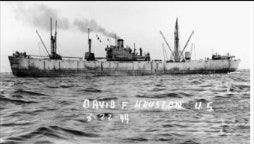
A ship named for his father SS David F. Houston
Wonder what his Father would think of this old thing. Nothing was ever said about it. IN THE PHOTO IT...LOOKS LIKE A WELL TRAVELED TRAMP STEAMER
SS DAVID F. HOUSTON
The 173rd ship built during World War II at North Carolina Shipbuilding Corporation, on the banks of the Cape Fear River was the SS DAVID F. HOUSTON.
This vessel was named in honor of the memory of David Franklin Houston [who died 1940]. On July 8, 1943, less than a month after the ship’s keel was laid, his daughter, Mrs. Helen Houston Cotton christened the vessel. The completed ship was delivered just a scant week later, on July 15, 1943, and chartered by the government to the Wessel Duval, Inc. shipping company.
Like the BICKETT, the HOUSTON was later converted to carry troops. 550 bunks,
stacked several tiers high were installed in
two of the ship’s forward cargo holds. A
galley, a mess hall and suitable, albeit
sparse, sanitation facilities were also
provided in adjacent spaces. Additional
ventilation, plus escape ladders and
hatches, completed the crude conversions.
These barely livable spaces were often
filled to over capacity.
Information about the ship’s wartime operational history is limited to a brief mention of her being in several large convoys that frequently sailed on several occasions from New York to Liverpool in early 1944. It can be assumed that she safely delivered troops and war material in support of the build-up that preceded the D-Day invasion later that year.
On one of these trips, the HOUSTON and another Liberty
collided in the Irish Sea while steaming in close formation with
dozens of other vessels. Such accidents were common when convoys changed course or whenever ships scattered to all points of the compass to avoid Uboats. Neither ship suffered any serious damage.
The SS DAVID F. HOUSTON was briefly laid up at the end of World War II in the
Hudson River National Reserve Fleet. In March of 1947 she was chartered to the North Atlantic & Gulf Steamship Company, but less than a year later was turned back over to the government and laid up in the Mobile, Alabama National Reserve Fleet.
She was subsequently sold for scrapping in early 1969 and demolished at the Pinto Island Metals Company in Mobile in July of that same year.